UNIT IV: MODERN EVOLUTION
I. Post-Darwinian Facts
C. Genetics
- The most definitive tests of hypotheses regarding biological relatedness come by testing hypotheses with DNA evidence, itself. Why? Because the only place an organism gets it DNA from is its parents, their parents, their great-grand parents, and their ancestors. The only reason two organisms would have similar DNA is that they got it from the same place. And, when we see that ALL organisms use the same genetic information (DNA), that suggests common ancestry - especially since it is read and decoded in the same exact way (Universal Code, and universal similarity in the process of mitosis and protein synthesis).
- Within a Species - So, If I am accused of fathering a child, and my DNA is similar to that child's DNA, then I can be "convicted" of being related to that child. That is the only reason two organisms will share DNA - because they are biologically related. DNA only comes from ancestors - it is replicated before meiosis and copies are passed to offspring.
1. Gross Chromosomal Similarities
- banding patterns in humans, chimps, gorillas, and orangs - very similar
- even the ‘exception’ (diff. in number) proves the ‘rule’ - the long #2 chromosome in humans is banded like two of the chromosomes in other primates, suggesting fusion of chromosomes in the human lineage (which does happen...such as in translocation events like the example of Translocation Down's used in class)
2. Sequence Analysis - 98.4% similar to chimp DNA.
- well, we are similar (mammals, primates, etc.) So, to be similar, don’t we need similar recipes? Well, perhaps.In this case, the argument is that the similarity is DNA structure is an ANALOGOUS similarity, representing similarities between organisms that function in asimilar way (but are not biologically related).
- But, only 10% of the genome is a recipe. Even the 90% that does not code for protein, that is random sequence, still shows this similarity. Even non-functional DNA is similar, so functional similarity (ie., ANALOGY) can’t be the answer…the similarity must be HOMOLOGOUS - the result of common ancestry.
3. Corroboration Between Independent Tests of Evolution
- The fossil record is presented as evidence of common descent
- Genetic similarity among living species is presented as evidence of common descent
- If these patterns are BOTH due to the same phenomenon (common descent), THEN their patterns should be the same. We should be able to use one to predict patterns in the other. They should give the same picture (and dates!!!)
- TEST THE THEORY OF EVOLUTION (YET AGAIN):
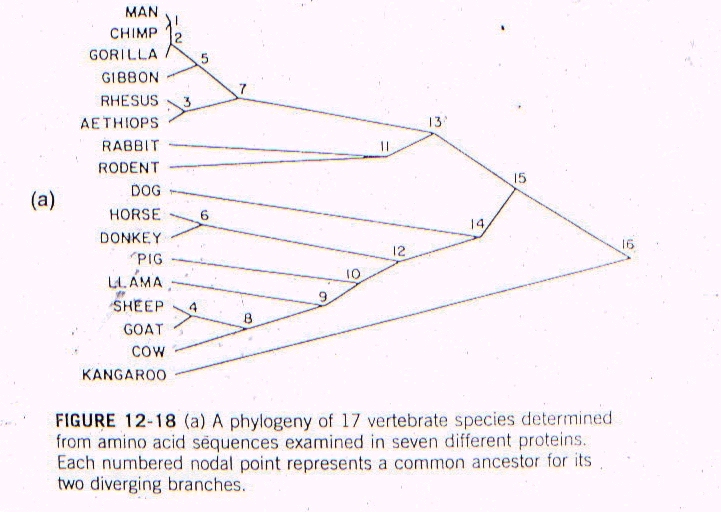
- In the following example, 7 proteins from 17 mammals were sequenced - their amino acid sequences were determined. Then, species were grouped based on the similarity of these protein sequences. The number at each "node" refers to the order of the clustering.... so the most similar pair of species is humans and chimps - they are linked at 'node 1'. Then, gorillas are more similar to humans and chimps than any other pair of taxa, so gorillas link to humans and chimps at node 2. Then, the next most similar pair of taxa are Rhesus monkeys and Aethiops monkeys, linked at node 3, and so forth. All placental mammals link together with one another before any link to the sole marsupial, the kangaroo.
Now, this is just a clustering procedure. It could be done on cars, nuts and bolts, anything. But since it is done on life forms, we can test an evolutionary prediction. Evolution suggests that organisms are similar because of common descent from shared ancestors. Species that are more similar, genetically, should have a more recent ancestor than organisms that are more different, genetically. So, there should be a relationship between 'time since divergence' and 'genetic difference'.
Well, using the group of organisms that we have, we can describe what evolution predicts that relationship should be:
IF: the oldest mammal in the fossil record is ancestral to all more recent mammals, and
IF: the most different groups of mammals today (placentals and marsupials) are descended from that ancestor, and
IF: the accumulation of genetic differences (mutations) occur at a constant rate,
THEN: We can plot 'node 16' based on the age of the oldest mammal fossil (120 mya) and the genetic difference measured between marsupials and placentals (98 substitutions in DNA).
AND: if mutation rate is assumed to be constant, we can draw a straight line from 'node 16' to the origin. This is the predicted relationship between genetic similarity and time - predicted by the theory of evolution by common descent.
So, evolutionary theory predicts that, if two mammals differ by 50 substitutions in these seven proteins, then it must have taken 58-60 million years for these differences to accumulate. In other words, their common ancestor should have lived 58-60 million years ago.
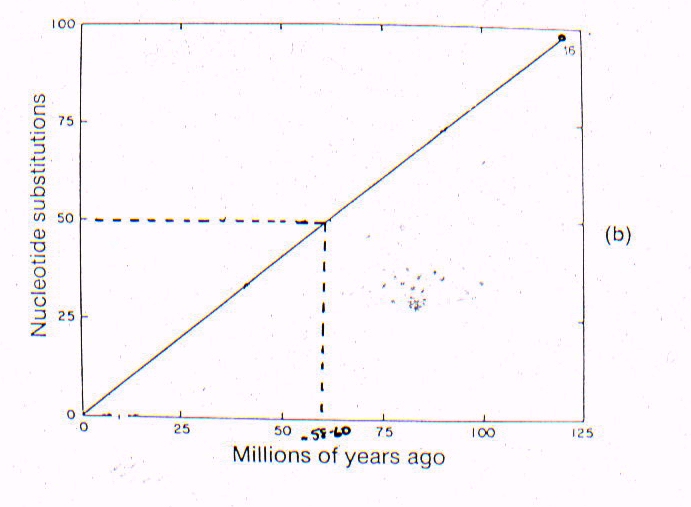
Well, horses and sheep differ by 50 substitutions in the DNA. Our model predicts that the common ancestor should live 58-60 million years ago. Well, where ARE the oldest ungulates in the fossil record? They are in strata that date to 58-60 million years old - just where the genetic analysis of existing species predicts they should be (see node 12, below).
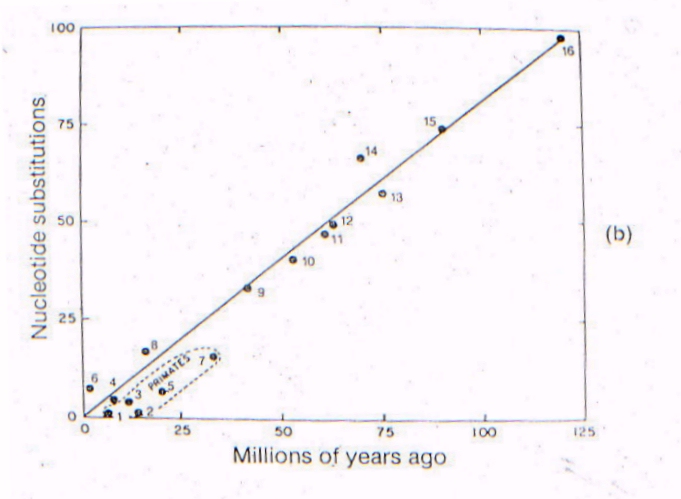
The intermediate fossils that link these taxa, and represent these numbered nodes, are pretty much where our genetic analysis of existing species predicts they should be. There is some variation - not all points are exactly on the line - but our assumption of a constant mutation rate is probably not explicitly correct for all genes, and probably introduces some slight source of error. None the less, the data is strongly supportive of our hypothesis - our evolutionary prediction has been confirmed by the data.
So, as we have mentioned before, evolution not only predict the existence of common ancestors, but genetic analyses of living species can predict WHEN, millions to hundreds of millions of years ago, these different, extinct, ancestral species lived. (Remember those intermediate fossils? It's not just that they have a combination of traits, but they existed at the right time. Now, we see genetics showing the same thing, in a PREDICTIVE way, like an good scientific theory should).
The only rational explanation that explains our ability to do this is evolution from common ancestors. This wouldn't work if evolution was false, radiaoctive dating was false, or genetic analyses did not reflect biological relatedness. All these 'assumptions' are confirmed by these types of experiments, as well.
Evolution is a predictive, explanatory model for how the universe works. It has been tested and supported in an extraordinary variety of ways. This tool works... it is irrational, even morally irresponsible (medical applications, for instance), NOT to accept it and use it.
Study Questions:
1. How can you compare molecules in organisms walking around on the planet today and predict where, in the sedimentary layers of the Earth's crust, a third differnt species should be? Explain in detail.